

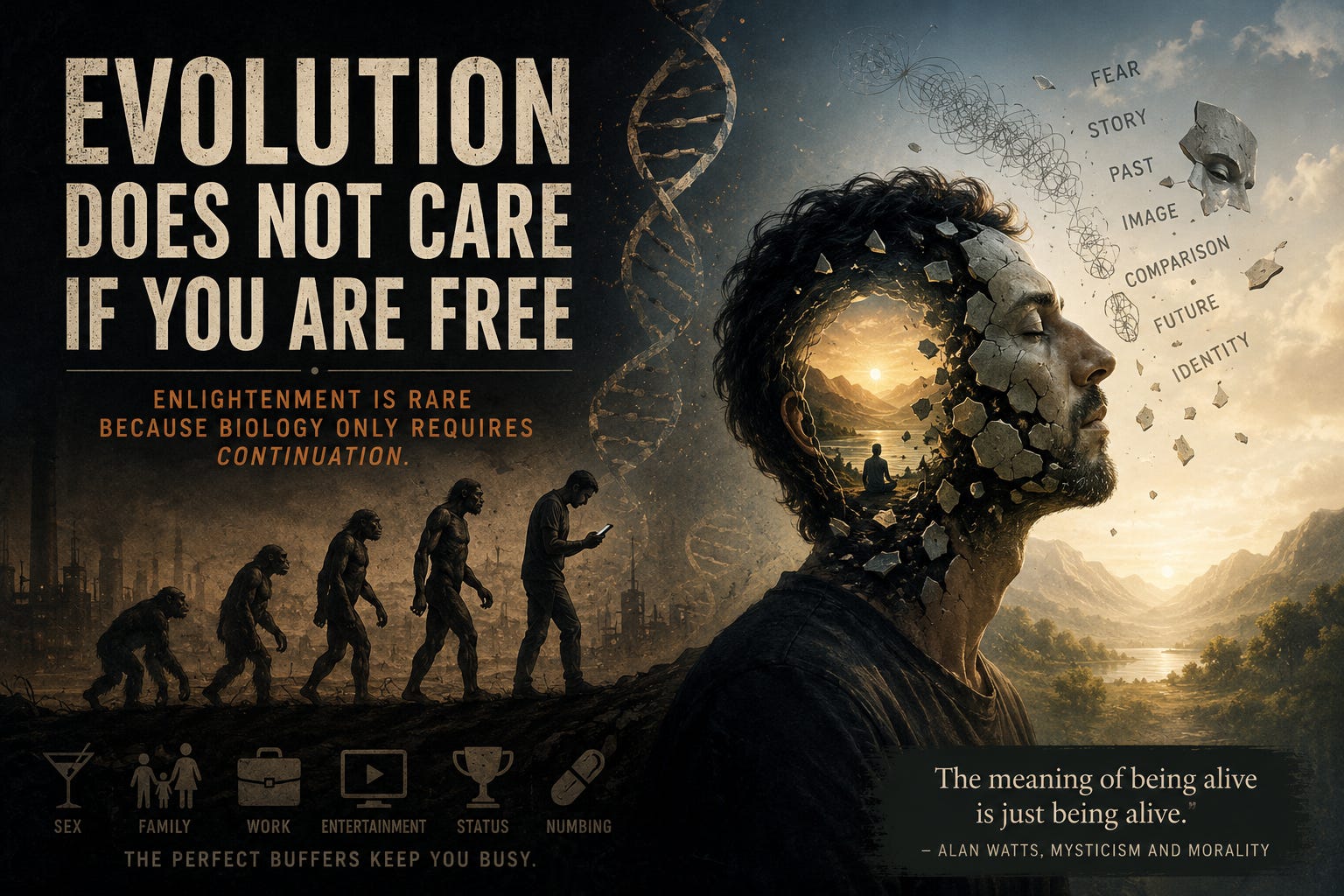
Evolution Does Not Care If You Are Free
Enlightenment is rare because biology only requires continuation.

Most spiritual cultures smuggle in a comforting assumption: that waking up is the “point” of human life, that suffering is somehow designed to lead us to wisdom, that truth is the natural direction of consciousness, or that the universe is quietly pushing us toward clarity.
I don’t buy any of that.
By enlightenment, I don’t mean sainthood, mystical superiority, or escape from biology. I mean something simpler: the perceptual shift where a person stops mistaking symbolic thought for reality, and a large portion of needless suffering drops away.
A Darwinian lens dissolves the spiritual fantasy immediately.
Evolution doesn’t optimize for truth. It doesn’t optimize for peace. It doesn’t optimize for the reduction of suffering.
It optimizes for one thing: continuation.
Genes that keep replicating persist. Genes that don’t, vanish. That’s the selection function. Everything else — meaning, virtue, insight, enlightenment — can be beautiful, but none of it is required for the evolutionary machine to do what it does.
Once you accept that, a lot of confusion dies.
You stop expecting biology to aim at awakening. You stop expecting suffering to be corrected by some cosmic principle. You stop expecting the universe to intervene. You stop treating enlightenment like an inevitability, or a moral accomplishment, or a destiny.
You start seeing it for what it is: a rare and optional deviation — astonishing in its availability, but unnecessary to the system that built us.
The world was never trying to soothe you.
It was trying to keep you running.
And it is extremely good at that.
What “Works” Means in Darwin’s World
When I say a life “works,” I’m not using the spiritual definition of “works.”
I’m using the only definition evolution cares about: does the organism remain viable long enough to pass on genes, or support the passing on of genes?
If yes, the strategy works.
If no, it doesn’t.
Notice what isn’t on that list.
There is no requirement that the organism be happy. There is no requirement that it be free. There is no requirement that it be honest. There is no requirement that it reduce suffering, for itself or for others.
There is only a requirement that it continue.
If suffering doesn’t block continuation, then suffering isn’t selected against.
People have enormous difficulty with this because they want suffering to be a signal that something is wrong in a way the universe cares about. But the universe doesn’t care about your inner narrative. Evolution doesn’t care about your peace. The cosmos doesn’t have a value hierarchy that privileges “less suffering” over “more suffering.”
It has physics.
It has energy flow.
It has births and deaths.
It has organisms adapting to conditions.
It has genes replicating.
If a human being is miserable but functional enough to reproduce, raise children, or help stabilize a reproductive social unit, the machine counts that as success. If a human being is peaceful but fails to reproduce, that may be spiritually admirable to us, but it is irrelevant to the evolutionary algorithm.
That is why you can see endless needless suffering on Earth without any correction.
Nothing is broken in the way the system measures “broken.”
The system measures continuation, not clarity.
Egoic Lives Can Be Successful End-to-End
Here’s a fact sentimental spirituality refuses to face:
Egoic lives often succeed completely.
People assume the ego is self-defeating. They assume avoidance collapses. They assume denial hits a wall. They assume truth wins. They assume that sooner or later, the pain gets so bad that a person must wake up.
Sometimes that happens.
Often it doesn’t.
A person can build an avoidance strategy that holds for an entire lifetime. They can numb. They can distract. They can rationalize. They can export their suffering into a family system. They can create a stable environment where other people carry the emotional load. They can use alcohol, work, sex, entertainment, religion, ideology, or status as painkillers.
And they can die without ever having to face what they were avoiding.
Not because they were evil.
Not because the universe punished them.
Not because the universe rewarded them.
Because the strategy functioned well enough.
I’ve seen it up close: a woman whose husband paid the bills, who was drunk within an hour of waking most days, who had her eldest daughter parent the other children. The family system stabilized around her coping mechanism. It “worked.” It created a stable enough environment for her lifestyle to continue.
She got to the end of her life.
When she was in her late 80s and doctors knew she would die soon, one of her daughters asked the doctor, “Should we sober her up?”
The doctor said, “At this point it would do more harm than good.”
So they brought vodka into the hospital.
That is not a tragedy story in the sentimental sense.
It is a proof-of-concept story.
It demonstrates something most of us don’t want to admit: you can ride conditioned avoidance behaviors all the way to the end. You can die inside a bypass. And the universe does not intervene.
Now add the second part, because this is the part that matters if we’re being accurate: the exported suffering doesn’t disappear.
It lands in the people around the person.
The eldest daughter becomes the parent. The spouse becomes the manager. The siblings become collateral. The family system bends itself around the unresolved pain of one person and calls that adaptation normal.
And then, most of the time, those recipients don’t wake up either.
They cope.
They find their own anesthetics.
They turn to entertainment, overwork, food, sex, substances, relationships, spirituality, ideology, achievement, fantasy, and on and on. They adopt their own stable patterns to make life tolerable. They keep going.
That can become intergenerational.
This is why the myth “suffering wakes people up” is so often false.
Suffering usually teaches better coping.
It teaches better numbing.
It teaches better avoidance.
It teaches better story-making.
It teaches better ways to keep functioning.
Functioning is what the machine rewards.
Lifespan Is an Epistemic Shield
Another reason awakening is rare is almost embarrassingly simple:
Eighty years isn’t long enough.
People assume time creates wisdom. Time does not create wisdom. Time creates more time spent inside a model.
What creates wisdom is data that overwhelms the model’s ability to rationalize itself.
That requires repeated failure cycles.
Not one heartbreak.
Not one career disappointment.
Not one humiliation.
Not one crisis.
It requires a long chain of “this didn’t work” that becomes so statistically obvious that the mind cannot plausibly blame the world anymore without noticing the common factor.
Most humans do not have enough iterations to be cornered by their own evidence.
In a typical lifespan, even a busy one, you might get:
• a handful of serious relationships
• a few major identity phases
• a few career arcs
• some losses
• some traumas
• some wins
• some humiliations
• some aging-related decline
But here’s the trick: the ego can patch itself through all of that.
It can blame the partner, the boss, the economy, the culture, the timing, the childhood, the politics, the hormones, the weather, the universe. It can reframe. It can spiritualize. It can build a new identity. It can pivot into a new coping system. It can anesthetize.
There often aren’t enough loops for the defense mechanisms to become computationally impossible.
This is why I sometimes say: if humans lived 5,000 years, a lot more of them would probably wake up — not because they became saints, but because their strategies would fail so many times that they would finally become obviously flawed.
Think about the 100th romance.
The 200th identity reinvention.
The 300th attempt to soothe yourself with achievement.
Eventually the excuses stop compressing reality. The denial becomes too expensive. The data pile becomes too large.
But humans don’t live 5,000 years.
Humans die before the model is cornered.
Death is not only a biological limit.
It is an epistemic shield.
It protects false strategies by ending the experiment before it produces enough evidence to force revision.
This is also why you can watch people die while reiterating their beliefs and unexamined narratives, surrounded by loved ones, convinced they lived well, never noticing what they never tested. Many lives are coherent, socially validated, and emotionally comforting at the end.
That doesn’t mean they were true.
It means they were stable enough to persist until the organism expired.
Evolution is satisfied with stable enough.
The Strongest Buffers: Sex and Family
Now add the biggest time-binding systems humans have.
One of the most common ways humans relieve stress is through sex. For most of human history, sex was a high-efficiency pipeline to reproduction. It reduced stress, created bonding, filled narrative space, and produced babies.
That is Darwinian perfection.
Sex is not just pleasure. It is an attention capture system. It is a bonding system. It is a meaning generator. It is a stabilizer. It creates alliances. It creates families. It creates social structures. It gives people something to do, something to want, something to chase, something to fear losing, something to fight over, something to sacrifice for, something to tell stories about.
For most of history, it also made babies.
That is a production line.
Birth control changes the output, but it does not change the wiring. The reward system didn’t update because we invented contraception. The brain still runs the same programs. Sex still soothes stress. It still bonds. It still distracts. It still fills time. It still generates meaning.
It just doesn’t necessarily generate children now.
But historically it did, and that is why the drive is so powerful.
Now add children.
Children are one of the most effective buffers against existential inquiry that humans have ever had. Parenting absorbs attention, time, and nervous-system bandwidth. It supplies automatic meaning. It reframes suffering as love. It offers moral insulation: “I did it for them.” It postpones self-inquiry: “later, when they’re older.” It binds people to roles. It creates social validation. It produces a narrative that can hold even when the internal world is a mess.
This isn’t an anti-kid argument.
It’s a systems argument.
Parenting is not bad.
For a brain built through the evolutionary process, it is close to the central assignment.
That is why it works so well as a buffer: it binds attention, supplies meaning, stabilizes roles, reinforces social structures, and keeps the lineage running.
If you combine sex, family, work, entertainment, and status into one life, you can keep a person busy enough that they never have to confront the deeper question at all. They can die mid-distraction, and it will look respectable.
This is one reason enlightenment is so rare:
The machine has extremely good buffers.
Biological Debt: When a Lineage Runs Out of Buffer
If the individual lifespan is an epistemic shield, the lineage is where some of the deferred cost begins to show up.
An individual can bypass their way to the grave. But the cost of that bypass does not vanish. It gets redistributed into the family system, the nervous systems of children, the emotional habits of a household, and sometimes into biological stress regulation itself.
Epigenetics may be one layer of this, but it is not the whole story.
The larger point is simpler: avoidance can work for one organism while increasing the load carried by the next.
When a parent survives by long-term numbing, suppressed terror, or exported rage, they are not simply “getting away with it.” Sustained activation of stress systems can alter hormonal regulation, immune signaling, and neural sensitivity. Chronic family stress can shift the atmosphere a child develops inside. The child does not merely inherit genes. The child inherits tone, threat level, emotional rules, nervous-system modeling, and the unspoken agreements that hold the household together.
Think of this as biological debt rather than biological fate.
The first generation incurs the debt by maintaining a high-stress, low-clarity equilibrium long enough to survive and reproduce. The debt is not merely a story. It is a cost. The next generation may inherit a system that reaches overload sooner, with fewer degrees of freedom for denial, dissociation, or numbing to remain effective.
Eventually, some lineages hit a saturation point.
You get what might be called the third-generation seeker — not because three generations is a rule, but because cumulative stress load has crossed a threshold.
The ancestral anesthetics no longer work.
Alcohol heightens anxiety instead of blunting it. Achievement fails to stabilize the nervous system. Family structure no longer absorbs the pressure. Religion becomes insufficient. Therapy regulates but does not dissolve the deeper confusion. The cost of staying asleep becomes higher than the cost of seeing.
At this point, the coping strategies that were stable for a grandparent become computationally expensive for the descendant.
The inherited nervous system is more sensitive, not weaker — less tolerant of incoherence, less able to amortize suffering across distraction. What once functioned as background noise now registers as an alarm.
This is why seekers so often appear in families that look, from the outside, as though they worked for decades.
The seeker is not more evolved or morally superior.
They are cornered.
Their sensitivity is not a virtue. It is a reduced capacity to keep lying without consequence.
Their biology no longer supports indefinite avoidance. The lineage has reached a point where it must either collapse into dysfunction or liquidate the debt by dropping the unnecessary load.
When someone finally stops mistaking symbolic representations for reality — when they stop feeding the abstractions that keep stress systems activated — they are not just relieving personal suffering.
They are interrupting the intergenerational transmission of a costly strategy.
They are paying a bill that biology allowed their ancestors to defer.
Why the Universe Doesn’t Intervene
At this point, some people try to reintroduce a comforting myth:
“Yes, but the universe wants us to wake up.”
“God wants us to wake up.”
“The cosmos wants us to evolve spiritually.”
“There is compassion built into reality.”
I understand the impulse.
But if we are being honest about what we observe, the universe is not running a project to reduce your suffering. It is not running a project to enlighten you. It is not running a project to correct your confusion.
Energy flows.
Organisms function.
Genes propagate.
Civilizations rise and fall.
Stars burn.
Planets orbit.
The universe does not need you to be awake.
And if we stay in Darwin’s frame, the point is even more blunt: evolution does not select against suffering.
It selects against failure to continue.
That is the meaningful difference.
Suffering can be intense and persist for decades and still not prevent reproduction. Suffering can even support reproductive behavior indirectly through bonding, conformity, dependence, social strategies, and role formation.
So it stays.
It does not get fixed.
It gets normalized.
This is why the phrase “the universe doesn’t intervene” is accurate. It is not cruel. It is not compassionate. It is not personal.
It is simply not in the business of optimizing your internal experience.
The Astonishing Part: The Exit Exists at All
And now we arrive at the real mystery.
Given how perfectly the system is tuned to keep us running, it is genuinely astonishing that an exit from needless suffering exists at all.
This is the point most spiritual talk gets wrong. It acts as if mass awakening is the miracle.
It isn’t.
Mass awakening was never likely. The system doesn’t require it. It doesn’t select for it. It doesn’t enforce it.
That is why it doesn’t happen.
The real miracle is that any organism can step out of unnecessary suffering without changing the external world.
From a Darwinian perspective, needless suffering did not have to be optional.
Misidentification did not have to be reversible.
The organism did not need the capacity to notice its own self-generated pain.
The brain could have been built so that thoughts simply compelled action and emotion without any possibility of disidentification.
And yet, in humans, there is a way to see what is happening and stop feeding the unnecessary part.
Not by becoming pure.
Not by killing biology.
Not by becoming an ideal.
Not by transcending desire.
But by recognizing that a portion of suffering is manufactured — generated by a particular set of brain networks and a particular confusion: the confusion of symbolic representations with reality itself.
That is the anomaly.
Pain exists across biology. But needless suffering is a more specific cognitive phenomenon. It requires certain machinery.
Trees do not manufacture symbolic suffering.
Most animals do not appear to either.
Humans do.
Human Suffering Is What Happens When Abstraction Goes Feral
If you want to locate the machinery behind needless human suffering, you don’t need theology first.
You need neurobiology.
Humans have:
• a powerful Default Mode Network
• language centers that can run unattended
• autobiographical memory
• future simulation
• social comparison abstraction
• narrative identity construction
This stack is incredible for survival.
It lets us plan, coordinate, predict, build culture, build tools, build alliances, anticipate danger, and navigate complex social hierarchies.
It also gives us the ability to suffer when nothing is happening.
That is the human specialty.
We can:
• fear without danger
• grieve without current loss
• feel shame without an audience
• replay symbolic humiliation for decades
• derive identity from failure
• imagine alternate lives
• rehearse future catastrophes that never occur
• create metaphysical despair
A dog can grieve. A primate can withdraw. Highly intelligent animals can show depression-like states, especially under loss, captivity, or severe environmental stress.
Their suffering has anchors in reality: actual deprivation, actual loss, actual instability.
Humans can suffer in a safe room, alone, with no threat present, because the upper brain can generate abstraction and treat it as real.
This is not a moral failure.
It is a feature of intelligence.
Once an organism can model time, self, and social meaning symbolically, it can generate internal conflict without stimulus. It can produce pain from prediction. It can produce terror from imagination. It can produce misery from thought.
That is why human suffering often feels needless.
It is often not tied to present reality.
It is tied to symbolic reality.
And here is the crucial point:
The same machinery that creates the problem makes the exit possible.
If the brain can generate symbolic narratives, it can also notice them as narratives. If the Default Mode Network can produce self-referential loops, awareness can notice the looping. If language can narrate the self into prison, perception can observe language as sound and thought rather than as truth.
Nothing mystical is required.
The system simply stops mistaking symbol for reality.
In that moment, suffering collapses to its proper scale:
• pain when there is pain
• grief when there is loss
• fear when there is danger
• silence when there isn’t
Animals don’t need enlightenment because they never fell into this particular trap to the same degree. They don’t build symbolic self-world models the way humans do. They don’t ruminate abstractly for decades. Their suffering is more event-bound.
Humans fell into the trap hard.
And humans can, rarely, step out.
Why Enlightenment Is Rare
If you want a simple answer, it is this:
Enlightenment is rare because it is not required, and because the buffers work.
Most humans never hit the wall where their coping strategies fail so completely that they are forced to look at the program itself. Most humans are not cornered by their own data.
Most humans have enough distraction to last a lifetime:
Sex.
Children.
Work.
Entertainment.
Status.
Ideology.
Religion.
Consumption.
Addiction.
Most humans can amortize suffering across a social system without having to face it directly.
Most humans die mid-bypass.
And even when a person is cracked enough to ask for help, they usually seek the most available supports: religion and therapy.
Those can be useful.
Sometimes profoundly useful.
But they often function as stabilization systems. They help people cope, regulate, and make meaning. They do not always deliver the perceptual shift that drops the needless part of suffering.
Sometimes they do.
Often they don’t.
There is also a brutal statistical fact: meeting someone who is genuinely shifted is rare.
The spiritual marketplace massively overrepresents people who want to teach and massively underrepresents people who have nothing to gain by teaching. A truly shifted teacher is not a charismatic performer, not a brand, not a spiritual entrepreneur, not someone building identity around being awake.
When you meet the real thing, the fake thing becomes obvious forever.
Many people never meet the real thing at all.
Some do.
Not because they deserve it.
Not because they were morally superior.
Not because they sought correctly.
Because the dice rolled that way.
Even intelligence doesn’t solve it.
IQ is like processing speed. Behavior is the program. All a high IQ does is run the program faster.
Sometimes that means the program generates more suffering per unit time. Sometimes it means the feedback loop compresses and the pain registers sooner. Sometimes it means a person burns through a chain of egoic strategies quickly enough that the cost becomes undeniable.
But intelligence also improves rationalization.
It can protect ego indefinitely by building better stories.
A high-powered mind can remain unfree for a very long time.
That is why enlightenment is rare even among the smart. If intelligence were sufficient, academia would be full of liberated people.
It isn’t.
Intelligence is an amplifier, not a savior.
The Ethic That Matters: Reduce Needless Suffering, Do No Harm
At this point, spiritual culture often makes another mistake: it converts awakening into an ideal.
It turns it into purity.
It turns it into performance.
It turns it into a moral achievement.
It tries to erase biology.
You can see the pathology in things like sexual repression framed as holiness, asceticism framed as superiority, desire framed as impurity.
That isn’t enlightenment.
That is ego wearing a white costume.
Real liberation is simpler.
It is not about becoming a spiritual ideal. It is not about killing desire. A sex drive with a loving, consensual partner is not a problem. It is not inherently suffering.
The problem is not biology.
The problem is needless suffering generated by misidentification and abstraction.
The basic ethic that remains when the needless suffering drops is boring, practical, and humane:
• reduce unnecessary suffering where you can
• do no harm to others
• stop exporting your unresolved pain into the world
• stop pretending your narratives are reality
• stop using spirituality as identity armor
That’s it.
No sainthood required.
No metaphysical claims required.
No “universe wants you awake” required.
Conclusion
Enlightenment is rare because it is not required.
Biology does not need you to be free. Society does not need you to be free. Your family system may not need you to be free. Your coping strategies may work well enough to carry you to the grave.
You can numb, strive, reproduce, consume, believe, perform, achieve, distract, and narrate your way through an entire lifetime.
And in Darwinian terms, if the organism continues and the lineage persists, the strategy worked.
That is the uncomfortable part.
The hopeful part is not that awakening is inevitable.
It is not.
The hopeful part is that the exit exists at all.
A human being can notice the machinery. A human being can see the symbolic layer as symbolic. A human being can stop treating thought as reality, identity as truth, and inherited suffering as an obligation.
Nothing in the universe forces that shift.
But nothing prevents it either.
Call to Action
Do not turn this into another belief.
Test it.
The next time suffering appears, ask one clean question:
“Is this pain tied to present reality, or am I paying for a symbolic construction?”
If there is real pain, feel it.
If there is real grief, let it move.
If there is real danger, act.
If there is only narrative, comparison, imagined future, replayed humiliation, inherited identity, or the demand to defend a self-image — look directly at the cost.
No one is coming to stop you from paying it.
And astonishingly, you do not have to keep paying.
“The meaning of being alive is just being alive.” — Alan Watts, “Mysticism and Morality”